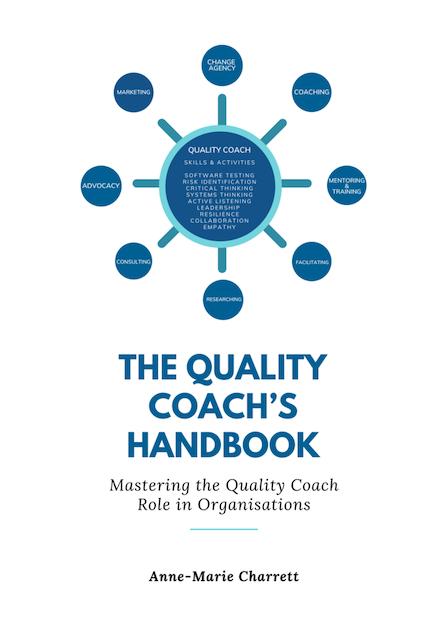
Book Review: The Quality Coach's Handbook
Target Audience
There is a dedicated section called “Intended Audience” that explicitly tells us who the target audience of the book is.
In Anne-Marie Charrett’s own words:
“Since quality is a shared responsibility, this book must be for everyone, not just quality professionals. It’s intended for software engineers, product managers, engineering managers, quality coaches, quality engineers, and anyone else wanting to improve quality.”
“The book is also intended for leaders and managers who are looking to understand how to support their teams in adopting a quality coach model. It provides practical advice and examples of how to implement a quality coach model in your organisation, as well as tips for leading and managing quality coaches.”
“It is also for those who are looking to understand the skills and competencies required for a quality coach, as well as how to describe the role of a quality coach in a way that resonates with different audiences.”
Based on how I read this book, while I do think the intended audience of the book makes sense - I would probably refine this a bit. I think quality coaches and embedded testers are those who would benefit the most from this book. If your company does not have anyone with “quality” or “test” in their job title, then I would recommend this book to those who are interested in quality who want to drive this, whether that be software engineers, product managers or engineering managers.
What I Thought About the Book
I enjoyed reading this book, which is jam-packed with Charrett’s wisdom.
In her book, Charrett covers topics such as:
- What is a quality coach
- Leading Quality coaching
- The differences between a softwarae tester and a quality coach (mainly: a tester is about what the person does, a quality coach is about what they can get others to do)
- The differences between a test lead and a quality coach
- Low cost ideas about getting started with Quality Coaching right away
And more.
There are a few insights that she shared in the book, which I particularly liked.
These include:
“The difficulty in having a software tester on a team isn’t that they ask uncomfortable questions…. The difficulty is the having someone on the team responsible for quality implicitly absolves the rest of the team from that responsibility.”
For a software tester, this can be rather frustrating since you can be seen as responsible for quality but in reality, you don’t have enough influence (or little influence) or control over how the software is being built.
Charrett also shared some concrete, useful, low-cost ideas to get from 0 to 1. (Ideas that have low chance of pushback from people)
There’s also some great ideas on how to incentivise teams when it comes to quality.
Reading Experience
At the start of the book, Charrett states that the book is designed to be dipped into - where you can read a chapter here and there on an as-needed basis. However, I found the reading a experience a bit weird because some chapters reference others - so you do need to go back and forth within the book a bit.
A good thing to note is that this book was written in the form of a newsletter. I believe each chapter was a newsletter issue - which means that some parts come across as a bit random if you are reading it the way I did from front to back (eg. The teachable moments in Quality Coaching chapter.
I want to also highlight that there are some chapters written by other people (guest authors for her newsletter). This means you get to benefit from others’ expertise as well. This does somewhat affect the reading experience but not to a huge degree.
There is a ‘Five Quality Coaching Tips (when coaching 10+ teams)’ chapter that covers Pair Testing. Pair testing is already covered in the book. No contradictions or anything like that though starts off with “I’m Gerard McCann. I love and work in Belfast…” which comes across a bit weird after reading the previous section. But if you were to read the book the way it is meant to (going straight to specific sections on an as-needed basis) then you shouldn’t notice this.
The book is chocka block full of Charrett’s wisdom on Quality coaching. (In other words, she has squeezed into a lot of knowledge into this book). I just want to reiterate it is not supposed to be consumed the way I read it. Follow her advice: read it the way it was designed to be read.